Where Image Becomes Language
In the quiet history of images, the name Morteza Momayez appears like a decisive stroke of ink. He is often called the father of Iranian graphic design, yet his true legacy lies elsewhere—in the way he taught images to think, and typography to breathe.
Born in Tehran in 1936, Momayez first learned the discipline of form at the University of Tehran, and later refined his vision in Paris at the École Nationale Supérieure des Arts Décoratifs. But education, for him, was not merely a place—it was a passage. Between Tehran and Paris he discovered a space where tradition and modernity could meet.
In that space, his work was born.
His posters were not simply designs; they were moments of distilled thought. A shadow, a fragment of a face, a line of type placed with quiet precision—these elements carried the weight of entire stories. The poster became a page of visual poetry, where silence was as meaningful as form.
Yet Momayez’s influence did not remain confined to paper. He helped shape the cultural structure of design itself, founding institutions such as the Iranian Graphic Design Society and initiating the Tehran International Poster Biennial, where Iranian design could encounter the wider world.
Through teaching, mentoring, and relentless cultural engagement, he ignited a generation of designers who would continue the dialogue he began.
And so his legacy remains—not only in posters preserved in archives, but in a way of seeing:
that design can hold memory,
that typography can carry emotion,
and that a single image, carefully composed, can speak for an entire culture.
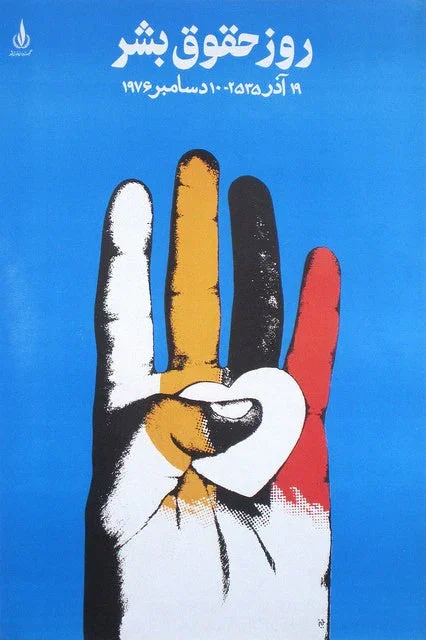
International Human Rights Day Poster-December 10. 1976